RAM & Memory Upgrades
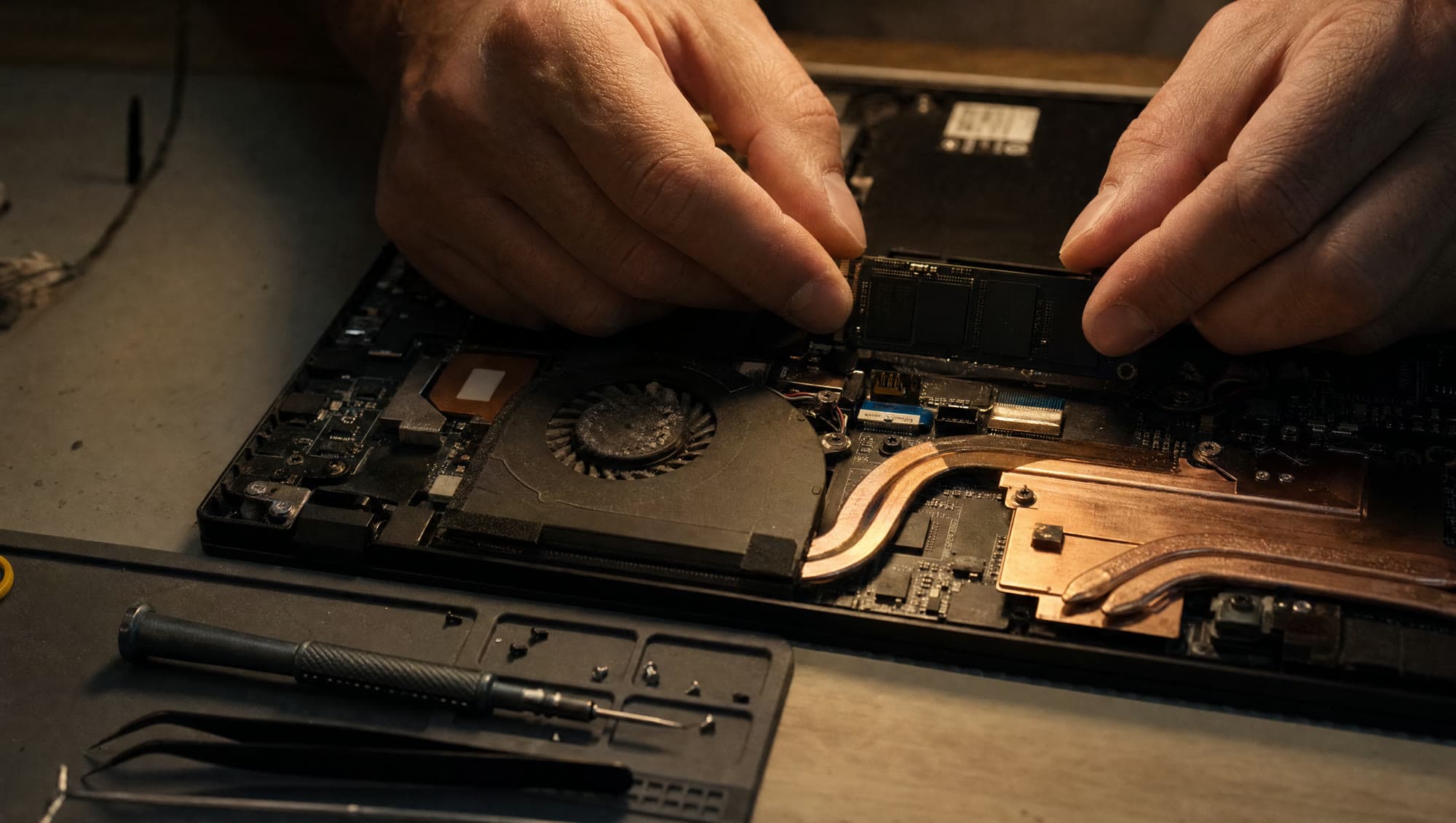
$49 labor plus the memory. Worth doing when memory is genuinely the bottleneck — and we'll tell you when it isn't.
- Price
- $49 labor + the memory
- Turnaround
- 1–2 days
- If we can't fix it
- The labor fee is on us
Sounds like your machine?
- Everything slows to a crawl with several browser tabs open
- Switching between programs takes seconds
- The machine is fine until you open a second big application
- Photo or video editing stalls constantly
- It has 4GB of memory and struggles with everyday work
- The drive light is busy whenever the machine pauses
Any of these and it’s worth a look. Diagnosis is included in the flat rate, so finding out costs you nothing extra.
When more memory is the answer — and when it isn't
Memory upgrades get recommended far more often than they help. Adding memory only speeds a machine up if it's genuinely running out; if it isn't, more memory does approximately nothing, and the money would have been better spent on a drive.
The tell is specific. A machine short on memory is fast when you're doing one thing and collapses when you open a second, with the drive light busy during every pause — that's the system shuffling data out to storage because it has nowhere else to put it. A machine that's uniformly slow at everything, including startup, usually has a drive problem instead.
We check which one you have before recommending anything. It takes a few minutes and it's the difference between $70 well spent and $70 wasted.
How much you actually need
For browsing, email, documents and streaming: 8GB is comfortable, and 4GB is now genuinely painful on both Windows and macOS. For heavy multitasking, photo editing or a lot of browser tabs: 16GB is the sweet spot for most people. For video editing, large CAD work or virtual machines: 32GB and up starts to earn its place.
Beyond that, more memory does nothing for most people. There's no benefit in headroom you never touch, and we'll say so rather than selling you the bigger kit.
What your machine can take
Every machine has limits: the number of slots, the maximum per slot, the generation of memory it accepts, and the top speed the board will actually run. Getting any of those wrong means memory that won't fit, won't post, or quietly runs slower than you paid for.
We check the specification for your exact model, see what's already installed and whether the existing modules can stay alongside the new ones, then source the right kit. Where possible we install matched pairs, which lets the memory run in dual channel and is measurably quicker than the same capacity in a single stick.
The main exception is soldered memory — common in thin laptops and standard on Macs from about 2017 — which cannot be upgraded by anyone at any price. We'll tell you within minutes if that's your machine, and we won't charge you for the disappointment.
What’s included
- Diagnosis of whether memory is genuinely your bottleneck
- Check of your model's maximum capacity, type and speed
- The right kit sourced and quoted before purchase
- Matched pairs for dual-channel operation where possible
- Installation and full memory error testing before collection
If we can't fix it, the labor fee is on us. Parts only billed when installed.
Questions we get asked
How much RAM do I need?
8GB is comfortable for browsing, email and documents. 16GB suits heavy multitasking and photo editing. 32GB and above is worth it for video, CAD or virtual machines. Beyond what you actually use, more memory changes nothing.
Will more RAM make my computer faster?
Only if you're running out of it. If your machine is fine with one program and collapses with two, yes — noticeably. If it's slow at everything including startup, the drive is the more likely culprit and an SSD is the better use of your money.
Can my laptop's memory be upgraded?
Many can, but not all. Thin laptops and Macs from roughly 2017 onward have memory soldered to the board, which can't be changed by anyone. We'll check your exact model and tell you straight away.
Do I need to buy the memory from you?
No. If you'd rather source it yourself, bring it and we'll fit it. We'd suggest checking the specification with us first — mismatched or unsupported memory is the most common reason a self-bought upgrade doesn't work.
Related repairs
Where we do this
We’re at 14327 MO-5, Sunrise Beach, MO 65079, on Route 5. People drive in from across the Lake of the Ozarks:
Let’s take a look at it.
Two minutes online, or just walk in during shop hours.
or call (573) 555-0142